Businesses today face constant pressure to manage costs, meet customer expectations, and keep operations running smoothly. Whether a company operates in manufacturing, retail, distribution, or e-commerce, maintaining the right quantity of products at the right time is essential. Too much stock can tie up working capital, while insufficient inventory can lead to delayed orders, lost sales, and dissatisfied customers.
A well-planned inventory strategy helps businesses balance these challenges. By improving purchasing decisions, organizing storage, monitoring stock movement, and using modern technology, companies can make their operations more efficient and reliable. A strong approach to inventory optimization can also help businesses respond better to market changes and maintain a competitive advantage.
Why Inventory Planning Matters for Businesses
Inventory is one of the most important assets for many businesses, but managing it efficiently requires more than simply keeping products in storage. Companies must identify their fast-selling products, slow-moving items, and the stock quantities they need to meet future demand.
Poor inventory planning can create several operational problems, including excess stock, shortages, increased storage expenses, expired or damaged products, and inaccurate financial records. These issues can affect cash flow and make it difficult for businesses to plan their next steps.
Businesses can use sales trends, historical data, supplier performance, and customer requirements to plan inventory. This helps them make better decisions. Instead of relying on assumptions, businesses can establish practical stocking levels that support daily operations while avoiding unnecessary costs.
Understanding the Importance of Inventory Optimization
The goal of inventory optimization is not to maintain the maximum amount of stock but to keep the right products available in the right quantities at the right time. This approach helps businesses reduce unnecessary inventory expenses while ensuring that important products remain available when customers need them.

Businesses can begin by reviewing their existing stock and identifying products that frequently run out, items that remain unused for extended periods, and products with unpredictable demand. This information can help create more accurate purchasing plans.
For example, a manufacturing company may need certain raw materials regularly, while other materials may only be required during specific production cycles. By analyzing these patterns, the company can avoid unnecessary purchases and improve production planning.
A structured inventory strategy also helps businesses reduce emergency purchasing, improve supplier coordination, and allocate resources more effectively.
How Warehouse and Inventory Management Work Together
Storage operations and stock control are closely connected. When products are stored without a proper system, employees may struggle to locate items, stock records can become inaccurate, and order processing may take longer than necessary.
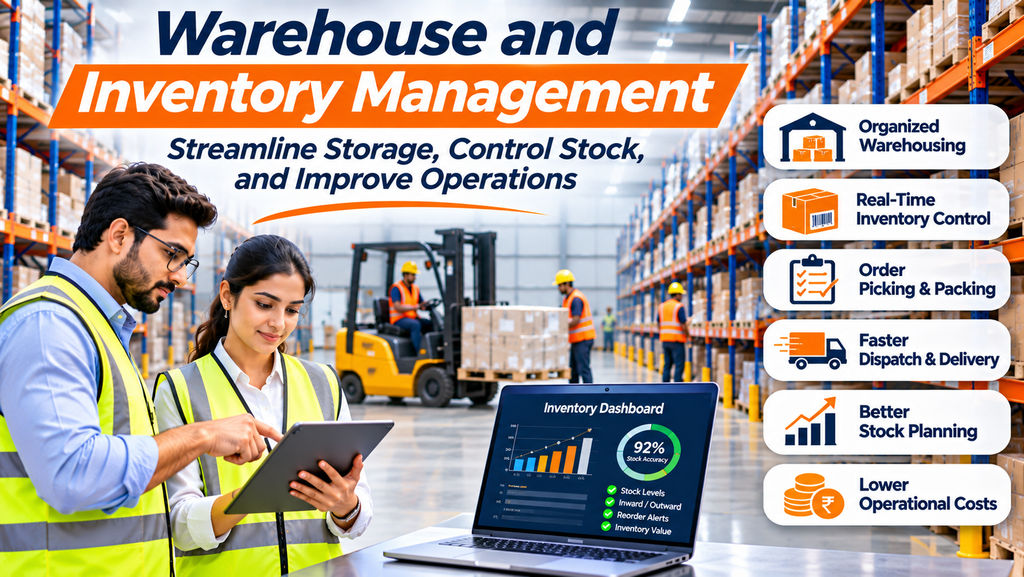
Effective warehouse and inventory management combines organized storage, accurate stock tracking, receiving procedures, picking and packing processes, and regular inventory checks. These activities help businesses maintain better visibility over their stock and reduce operational confusion.
Organize warehouse storage locations clearly. Use suitable product labels and efficient movement paths. Create clear processes for incoming and outgoing goods. Fast-moving products can be placed in easily accessible areas, while slow-moving inventory can be stored in locations that do not interfere with daily operations.
Businesses should also establish standard procedures for receiving goods, verifying quantities, recording stock movements, and handling returns. These small improvements can make a significant difference in warehouse productivity.
The Role of Demand Forecasting in Stock Planning
Demand forecasting helps businesses estimate how much inventory they may need in the future. Accurate forecasting can reduce the risk of overstocking and stock shortages, particularly when demand changes according to seasons, market trends, customer preferences, or promotional activities.
Businesses can use historical sales data, market information, purchasing trends, and upcoming business requirements to make better forecasts. Forecasting should also consider supplier lead times, product availability, and potential delays.
In service-based industries, forecasting demand for services is equally important. Companies providing maintenance, logistics, consulting, or technical services may need to plan staffing, equipment, materials, and resources according to expected customer demand.
Regularly reviewing forecasts allows businesses to adjust purchasing and resource allocation before problems arise. Instead of reacting to sudden changes, they can prepare in advance and maintain smoother operations.
Using Technology to Improve Inventory Accuracy
Manual inventory tracking can become difficult as businesses expand their product ranges, locations, and order volumes. Spreadsheets and paper-based records may work for smaller operations, but they can become unreliable when multiple employees are handling stock movements.
A warehouse management system can help businesses track inventory in real time, record product movements, manage storage locations, process orders, and improve stock accuracy. Depending on the system, businesses may also benefit from barcode scanning, automated alerts, reporting dashboards, and integration with purchasing or accounting software.
Technology reduces repetitive tasks. It also gives managers reliable information to make better decisions. However, implementing software alone is not enough. Employees must receive proper training, data must be maintained accurately, and processes should be clearly defined.
Businesses with complex warehouse operations may also explore SAP warehouse management to support structured inventory processes, warehouse activities, and operational visibility within larger business systems.
Practical Ways to Reduce Excess Stock and Stockouts
Improving inventory performance does not always require a major investment. Businesses can begin with simple operational changes that address common stock-related problems.
First, categorize inventory according to value, usage, and importance. High-value or critical products may require closer monitoring, while low-value items can often be managed through simpler replenishment procedures.
Second, establish minimum and maximum stock levels for frequently used items. These levels should be reviewed regularly based on actual demand and supplier lead times.
Third, maintain communication with suppliers. Reliable supplier relationships can help businesses receive products on time, negotiate better purchasing terms, and reduce uncertainty during replenishment.
Fourth, conduct regular cycle counts rather than waiting for a full annual inventory audit. Checking selected products at regular intervals can help identify discrepancies before they become larger problems.
Finally, review slow-moving and obsolete stock. Businesses should identify products that are no longer required and develop appropriate plans to reduce excess inventory without unnecessarily disrupting operations.
Building a More Efficient Warehouse Operation
Warehouse efficiency depends on how well people, processes, space, and technology work together. Businesses should regularly evaluate whether their warehouse layout supports smooth movement from receiving to storage, picking, packing, and dispatch.
Clear labeling and location codes can help employees find products quickly. Standardized picking procedures can reduce errors, while appropriate storage methods can protect goods from damage.
Employee training is another important factor. Warehouse teams should understand how inventory records are updated, how stock discrepancies are reported, and how products should be handled.
Businesses should also monitor key performance indicators such as inventory accuracy, order fulfillment time, stockout frequency, carrying costs, warehouse space utilization, and order picking accuracy. These measurements can help identify areas where processes need improvement.
How Professional Inventory Management Services Can Support Growth
As businesses grow, inventory requirements become more complex. Managing multiple suppliers, product categories, warehouses, and customer orders can place additional pressure on internal teams.
Professional inventory management services help businesses review existing processes. They identify inefficiencies and improve stock planning. They also help businesses create structured inventory procedures. The right support can help organizations reduce avoidable costs, improve visibility, and build scalable operations.
Businesses should look for solutions that align with their operational requirements rather than adopting processes simply because they are popular. Every business has different products, demand patterns, storage requirements, and supply chain challenges.
A practical inventory strategy should be flexible enough to support current operations while preparing the business for future growth.
Conclusion
Efficient stock management is essential for businesses that want to control costs, improve customer satisfaction, and maintain reliable operations. Better planning, organized warehouse processes, accurate records, demand forecasting, and technology can all contribute to stronger operational performance.
By regularly reviewing inventory practices and addressing inefficiencies, businesses can make better purchasing decisions, improve warehouse productivity, and reduce unnecessary expenses. A structured approach also helps companies adapt to changing customer demand and business requirements.
At Gitakshmi Enterprise, businesses can explore practical solutions to improve inventory planning, warehouse processes, and overall operational efficiency. Investing in better inventory practices today can help create a more organized, cost-effective, and dependable business operation for the future.
Looking to improve your inventory processes and warehouse efficiency? Contact Gitakshmi Enterprise to discuss your business requirements and explore practical solutions for better inventory control and operational performance.