

The Death of Traditional SCM: Why Modern Supply Chains Fail Without Autonomous Logistics
In an era defined by compressed delivery timelines, shifting consumer expectations, and volatile freight markets, enterprise supply chains cannot afford friction. Traditionally, companies treated storage, inventory handling, packaging, and freight distribution as isolated tasks managed by separate contractors. A manufacturer would produce goods, store them in a third-party warehouse, ship them across town to a contract packaging facility for assembly or labeling, and hand them off to a freight carrier for final transit.
This fragmented structure is inefficient. Every additional touchpoint increases product handling, multiplies paperwork, delays dispatches, and introduces points of failure where goods can be scratched, crushed, or lost.
Modern enterprise logistics relies on a combined approach: integrated warehousing and packaging solutions. Consolidating warehousing, value-added packaging, inventory tracking, and multi-modal outbound logistics under a single unified roof allows organizations to turn fulfillment from an operational headache into a competitive advantage. Specialized supply chain partners like Gitakshmi Enterprises deliver this integrated model, streamlining cargo handling from primary storage to retail and export distribution.
1. What is Integrated Warehousing and Packaging?
At its simplest, integrated warehousing and packaging merges standard storage operations with end-to-end protective packaging, secondary assembly, and fulfillment workflows within a single facility.
Instead of moving pallets across multiple regional hubs, items stay in designated storage positions—such as selective pallet racking or drive-in systems—until purchase orders trigger fulfillment. Pickers transport items straight to specialized, on-site packaging lines where workers wrap, kit, box, palletize, and label them according to client and regulatory specifications. The consolidated consignments then move directly onto outbound trailers or shipping containers.
Traditional Fragmented Logistics:
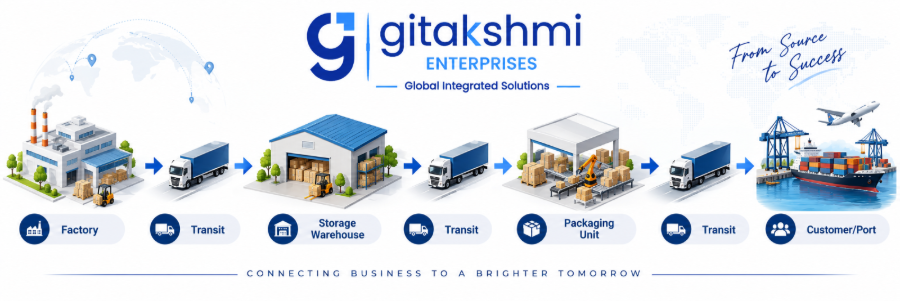
Result: 3 separate freight legs, high transit damage risk, multiple vendor handoffs.
Integrated Logistics Architecture (Gitakshmi Model):
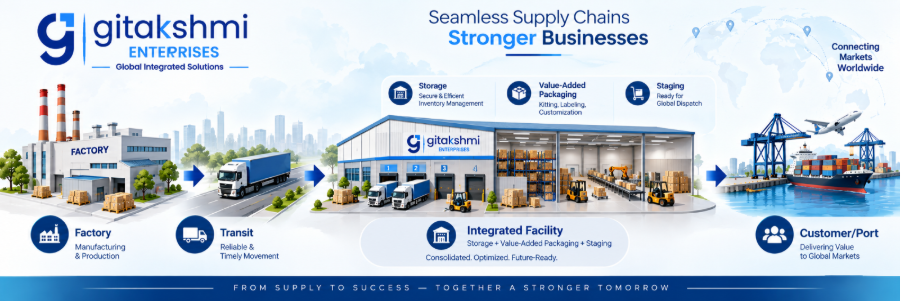
Result: 1 storage touchpoint, zero inter-facility transit waste, unified accountability.
This model provides continuous custody, unified warehouse management data, and clear operational ownership across the entire distribution lifecycle.
2. Core Drivers Behind Rising Demand for Unified Operations
The shift toward combined warehousing and industrial packaging is driven by clear operational and financial realities:
- Rising Dimensional Weight (DIM) Freight Pricing: Freight carriers and express parcel networks charge based on dimensional weight whenever package volume exceeds actual deadweight. Oversized, poorly packed cartons waste cargo volume and run up unnecessary freight charges. On-site packing teams analyze SKU dimensions and use right-sized cartons to keep costs down.
- Complex Multi-Channel Fulfillment (Omnichannel Demands): Modern manufacturers fulfill three distinct channels from one inventory pool: bulk B2B distribution to wholesale distributors, direct store deliveries (DSD) to modern retail outlets, and direct-to-consumer (D2C) e-commerce parcels. Each channel requires different packaging, barcoding, and protective dunnage.
- Higher Packaging Compliance and Regulatory Mandates: Export cargo heading through international sea hubs demands heat-treated pallets complying with ISPM-15 standards, alongside moisture barriers, desiccant bags, and specialized customs labels. Running these compliance operations directly in the primary storage facility prevents port rejections and costly customs clearance holds.
3. The 4-Stage Warehouse Packing Workflow
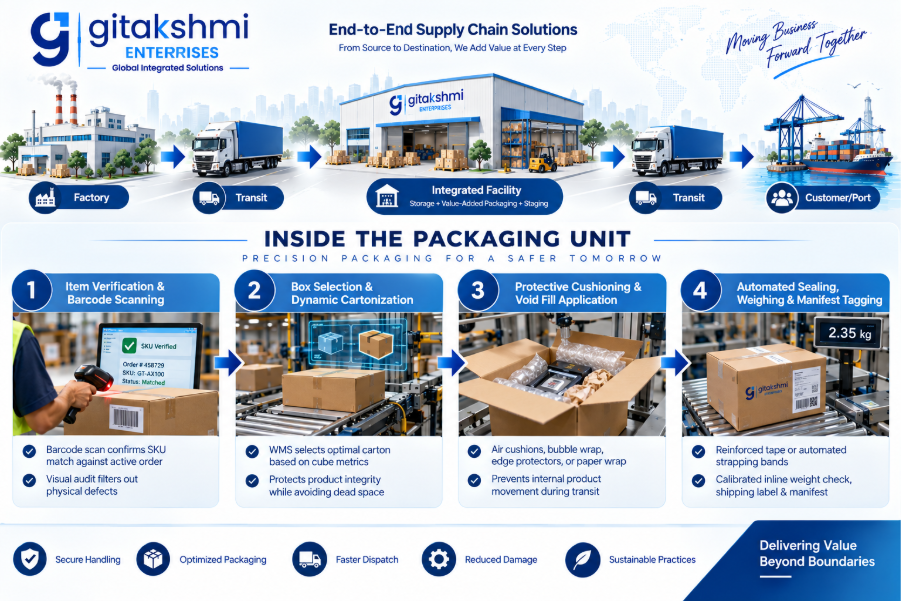
Stage 1: Item Verification and Barcode Scanning
The process begins the moment goods arrive from the storage aisles via conveyor systems, forklifts, or autonomous mobile robots (AMRs).
At the packing station, operators scan each item’s unique barcode into the facility’s Warehouse Management System (WMS). The system cross-checks SKU codes, batch numbers, lot details, and quantities against the customer’s purchase order. This step catches picking mistakes before boxes are sealed. Operators also check the external condition of the items, routing damaged or dented goods to quality control rather than packing them for dispatch.
Stage 2: Packaging Selection and Dynamic Cartonization
Instead of leaving box selection to guesswork, modern packaging systems use cartonization algorithms. The software calculates the total cubic volume of the items and recommends the right box size from a standardized set of options.
Using the correct box size prevents two common packing problems:
- Under-packing: Squeezing products into undersized cartons causes split seams, torn corners, and crushed goods.
- Over-packing: Placing small items in oversized boxes wastes expensive void-fill material and drives up dimensional freight charges.
Stage 3: Protective Cushioning and Void Fill Application
After placing items inside the carton, packers add protective cushioning to secure them against vibration, drops, and impacts. Depending on product fragility, packers use:
- Air Pillows and Bubble Wraps: Lightweight plastic films that cushion delicate consumer goods, glassware, and electronics without adding shipping weight.
- Kraft Paper and Crumpled Dunnage: Clean, recyclable paper padding that braces dense industrial components, hardware, and automotive parts.
- Molded Pulp and Custom Foam Inserts: Pre-shaped inserts engineered to hold specific equipment contours securely in place.
- Corner Boards and Edge Protectors: Heavy-duty pressed cardboard angles that protect box rims and stabilize pallet edges under tight strapping.
Stage 4: Automated Sealing, Calibrated Weighing, and Manifest Tagging
Once the dunnage is in place, the carton moves to closure:
- Sealing: Packing stations use automated tape dispensers applying reinforced water-activated tape (gummed paper tape) or pressure-sensitive acrylic tape. Water-activated tape fuses directly to the corrugated fibers, creating a tamper-evident seal that cannot be peeled back and restuck unnoticed.
- Weighing: Inline scales capture exact package weight down to the gram. The WMS compares this real-world weight to the theoretical weight calculated from the product catalog. A discrepancy signals a missing component or excess material, routing the box to an audit station.
- Labeling: Automated print-and-apply applicators place shipping labels, GS1 barcodes, carrier tracking tags, and mandatory warning labels (e.g., “Fragile,” “This Side Up,” or hazard diamonds) cleanly on the carton exterior.
4. Primary, Secondary, and Tertiary Packaging Breakdown
Effective industrial logistics requires a clear understanding of the three distinct packaging levels:
Packaging Layer | Primary Function | Typical Materials & Formats | Real-World Application |
Primary Packaging | Direct containment; protects internal product integrity, freshness, and surface finish. | Polyethylene barrier bags, aluminum foil pouches, glass bottles, blister clamshells, thermoformed trays. | The sealed foil bag enclosing bulk pharmaceutical APIs or the anti-static bag shielding bare printed circuit boards (PCBs). |
Secondary Packaging | Groups individual units together into trade packs; provides stacking strength and branding. | 3-ply, 5-ply, and 7-ply corrugated shipping cartons, die-cut display outers, shrink-wrapped multi-packs. | A heavy-duty 5-ply corrugated shipper holding 24 retail units, fitted with custom cardboard dividers to stop glass-to-glass contact. |
Tertiary (Bulk) Packaging | Secures consolidated shipments for bulk handling, pallet racking, and container freight. | Heat-treated wooden pallets, composite plastic pallets, multi-layered stretch films, steel and PET strapping, cargo netting. | A 1.2-meter high pallet stacked with 40 master cartons, secured with machine-applied stretch wrap and PET straps for intermodal sea transit. |
Industrial Focus: The Importance of Tertiary Palletization
Tertiary packaging carries products through supply chain transit. A failed stretch-wrap layer or weak pallet base can cause an entire stack to collapse during braking or heavy seas, damaging thousands of dollars of product.
High-efficiency packaging operations prioritize proper tertiary palletization:
- Standard Pallet Footprints: Operating on standard platforms like 1200 x 1000 mm or Euro 1200 x 800 mm pallets simplifies racking layout and maximizes container floor utilization.
- Interlocking vs. Column Stacking: While interlocking boxes like bricks provides lateral stability, column stacking (aligning box corners directly on top of each other) maintains full vertical wall strength, resisting pallet sag under heavy loads.
- Stretch Film Tensioning: Automated turntable wrappers apply consistent stretch tension, locking the bottom box layer directly to the wooden pallet runners to prevent the load from shifting during transport.
5. Cost-Benefit Comparison: Fragmented Logistics vs. Integrated Warehousing
Operational Metric | Fragmented Logistics (Split Vendors) | Integrated Warehousing & Packaging (Gitakshmi Model) |
Inter-Facility Transport | Regular shuttles move inventory from warehouse to contract packager, burning fuel and wasting time. | Zero local transfer. Products roll straight from storage racks to adjacent packaging lines on conveyors. |
Handling Touches | Typically 8 to 12 manual touches (unloading, re-palletizing, staging, moving, re-loading). | Reduced to 3 to 5 touches. Inventory moves directly from picking to the pack station and outbound staging. |
Transit Damage Rate | Higher (often 1.5% to 3.5%) due to repeated road transit and forklift moves. | Consistently below 0.2%. Goods stay secured on initial pallets until final packaging and dispatch. |
Turnaround Time (TAT) | 3 to 7 days to transfer stock, schedule external packing slots, and dispatch. | Same-day or next-day dispatch. Pack lines pull directly from on-site buffer stock as orders drop. |
Tracking & Accountability | Disjointed records; vendors often blame each other when shipments are lost or damaged. | Single digital audit trail. One integrated WMS tracks items from inbound receipt to final outbound bill of lading. |
Packaging Material Inventory | Cartons and wraps are often ordered on guesswork, leading to stockouts or excess holding costs. | Synchronized replenishment. Packaging stock levels are managed alongside core product inventory. |
6. Value-Added Services (VAS) Inside the Modern Warehouse
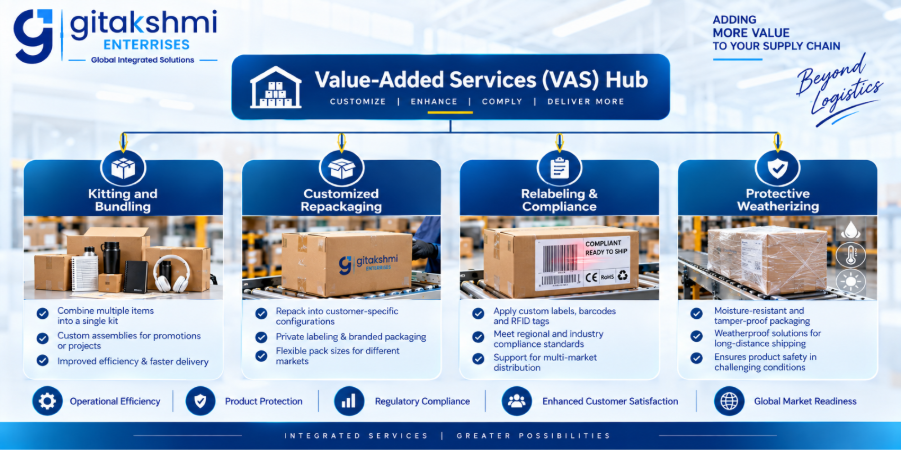
- Kitting and Component Bundling: Grouping specific hardware, fasteners, or promotional gift sets into single sellable SKUs before distribution.
- Customized Repackaging and Decanting: Decanting bulk containers, sacks, or drums into retail-ready cartons or smaller bags in clean packing zones.
- Relabeling, Barcode Over-Stickering, and Localization: Affixing regional MRP labels, destination-specific statutory disclosures, and GS1-128 compliance identifiers.
- Protective Weatherproofing and Export Preservation: Applying Vapor Corrosion Inhibitor (VCI) films and industrial vacuum-seal desiccants to protect precision metal parts and machinery from salt spray and humidity during ocean transit.
7. Warehouse Packing Station Ergonomics, Tech & Quality Control
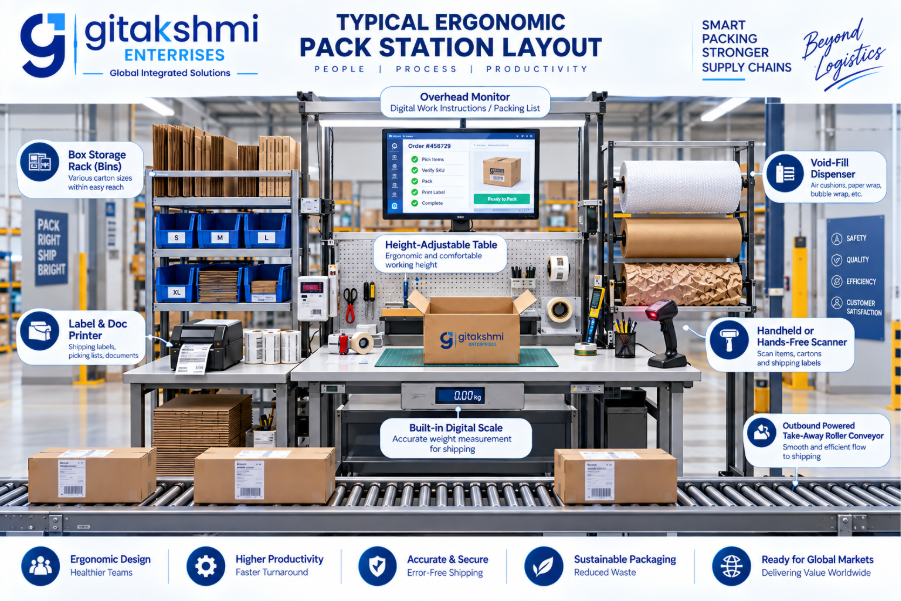
- Station Layout & Worker Ergonomics: Reach zones keep tape dispensers, scan guns, and shipping labels within forearm length, while flush-mounted scales eliminate repetitive lifting.
- Visual Pick-to-Screen Verification: Dual screens show operators real-time photos, batch numbers, and exact counts to eliminate picking and packing errors.
- Weight-Tolerance & Dimension Gates: Automatic scales lock label printing if packed weight deviates from system benchmarks, while overhead optical dimensioners instantly capture parcel volume for freight calculation.
8. Material Science in Warehousing: Selecting Corrugated, Films & Tapes
- Corrugated Board Profiles: 3-ply (Single Wall) for light items up to 10 kg; 5-ply (Double Wall) as the master shipping benchmark up to 30 kg; and 7-ply (Triple Wall) for heavy machinery parts and export crates. Fluting choices like B-Flute provide puncture resistance, while C-Flute delivers superior vertical compression strength.
- Stretch Wrap Formats: Cast film offers optical clarity for scanning barcodes through wrapped pallets, whereas blown film provides extreme puncture resistance for sharp, irregular industrial loads.
- Adhesive Solutions: BOPP acrylic tapes handle standard ambient sealing, while reinforced Water-Activated Tape (WAT) bonds permanently to corrugated paper fibers to provide tamper-evident security.
9. Sustainable and Eco-Friendly Packaging Operations
With ESG standards becoming central to enterprise operations, modern warehouses cut single-use waste at the source:
- Plastic-Free Paper Dunnage: Replacing expanded polystyrene peanuts with 100% recyclable on-demand crumpled kraft paper pads.
- On-Demand Right-Sizing: Dynamic box-cutting equipment builds customized cartons to size, cutting void space and increasing truck load capacity by up to 30%.
- Closed-Loop Returnable Totes: Heavy-duty returnable plastic containers and pallets between factories and warehouses eliminate recurring corrugated waste.
10. Regional Spotlight: Industrial Warehousing and Logistics in Gujarat
Gujarat serves as one of India’s major industrial backbones, producing a high volume of chemicals, pharmaceuticals, textiles, plastics, machinery, and automotive components.
For companies manufacturing in or distributing through Western India, warehouse location is critical. Storage and packaging setups in strategic hubs around Ahmedabad and the port corrid
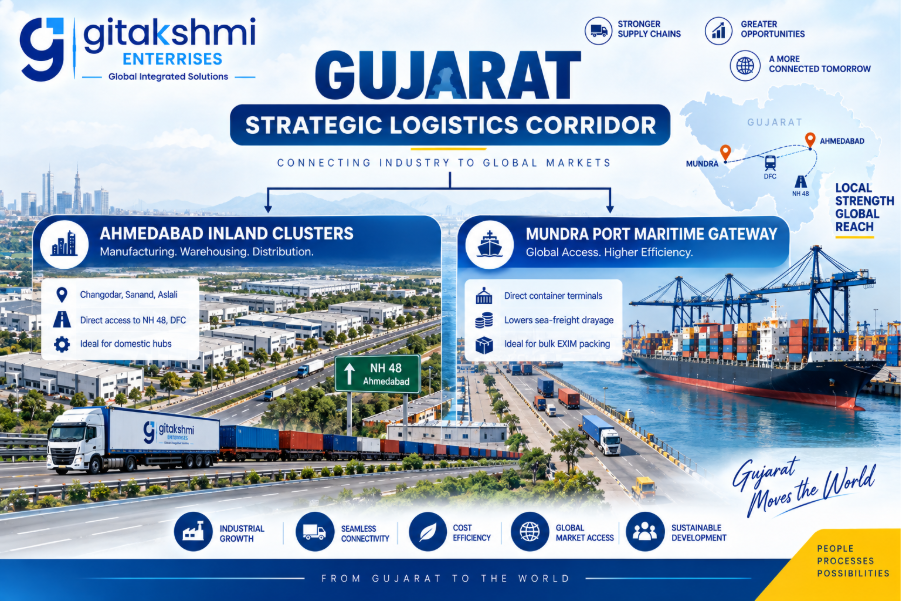
or of Mundra offer distinct logistics advantages:
Strategic Ahmedabad Industrial Clusters
- Aslali and Kheda Corridor: The historic hub for regional road transport along National Highway 48. Facilities here provide fast cross-docking and distribution access into central Gujarat, Maharashtra, and North India.
- Changodar and Moraiya: A busy manufacturing belt with specialized packaging lines, clear height warehousing, and direct links to heavy industrial machinery, consumer goods, and chemical suppliers.
- Sanand GIDC: A major automotive and engineering cluster requiring rigorous industrial packaging, specialized containerization, and just-in-time (JIT) parts staging.
Mundra Port Access: The Export-Import Hub
Positioning buffer storage and packaging operations close to Mundra Port helps EXIM businesses avoid inland drayage delays. Consolidating breakbulk goods, packing export boxes onto heat-treated pallets, and stuffing sea containers adjacent to port terminals saves significant time over packing at inland factories and hauling containers hundreds of miles across congested roads.
Integrated service providers like Gitakshmi Enterprises operate across this logistics network, combining Grade-A storage, customized packaging, and multi-modal transport. Managing warehousing, box packing, and outbound shipping through one dependable team helps businesses run lean, efficient supply chains across Gujarat and surrounding industrial corridors.
11. Step-by-Step Implementation Roadmap: Onboarding an Integrated Partner
Transitioning from fragmented, multi-vendor logistics to a consolidated warehousing and packaging partner requires a structured approach across five clear phases:
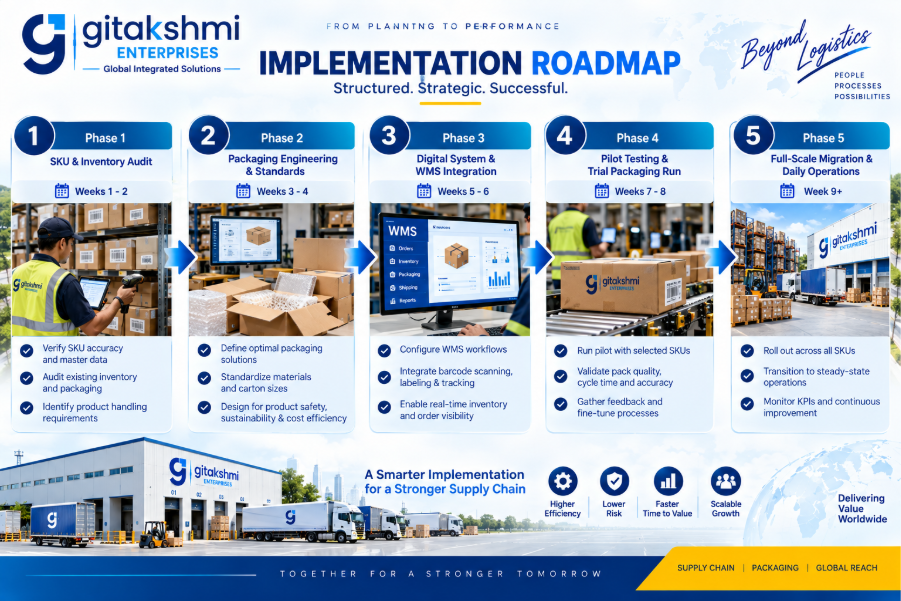
- Phase 1: SKU Profile and Packaging Audit (Weeks 1 to 2): Audit dimensions, weights, fragility, and historical damage data across all catalog items.
- Phase 2: Packaging Engineering and Standards Design (Weeks 3 to 4): Standardize on 4 to 6 core carton sizes and specify exact dunnage and strapping profiles.
- Phase 3: Systems Integration and Inventory Sync (Weeks 5 to 6): Connect your ERP (SAP, Microsoft Dynamics, or custom databases) with the warehouse WMS using secure API or EDI protocols.
- Phase 4: Pilot Testing and Trial Packing Runs (Weeks 7 to 8): Run test dispatches on selected product lines to confirm transit safety, barcode readability, and turnaround benchmarks.
- Phase 5: Full-Scale Migration and Ongoing Improvement (Week 9 Onward): Transition remaining stock to the integrated facility, monitoring SLAs and working with partners like Gitakshmi Enterprises to continuously optimize material usage and freight costs.
12. Frequently Asked Questions (FAQs)
What is the primary difference between a 3PL warehouse and an integrated packaging warehouse?
A standard 3PL warehouse focuses primarily on basic storage, put-away, and simple pallet or case picking. An integrated packaging warehouse combines those storage functions with dedicated secondary packing lines, automated cartonization, kitting, product bundling, relabeling, and compliance weatherproofing. Goods are customized, packed, and labeled for dispatch right on the warehouse floor without needing third-party packing contractors.
How does on-site packaging help reduce dimensional (DIM) weight shipping costs?
Couriers and freight companies bill based on dimensional weight whenever package volume exceeds actual deadweight. When packaging is handled by external vendors, workers often default to oversized boxes stuffed with excess bubble wrap or void fill. An integrated warehouse uses cartonization software that calculates the exact dimensions needed for picked items, selecting the most compact box possible. This eliminates dead air inside the carton, keeping dimensional weight low and cutting freight costs.
What are ISPM-15 wooden pallets, and why are they necessary for warehouse packing?
ISPM-15 (International Standards for Phytosanitary Measures No. 15) is an international standard requiring raw wood packaging thicker than 6 mm to be debarked and heat-treated or fumigated against insects and pests. Pallets treated to this standard receive an official branded stamp. Using ISPM-15 compliant pallets during tertiary warehouse packing is mandatory for export cargo; non-compliant pallets can be turned away, quarantined, or destroyed by foreign customs authorities.
Can custom kitting, multi-packs, and barcode labeling be managed for high-volume promotional runs?
Yes. Modern integrated packaging facilities maintain dedicated value-added service (VAS) areas built for fast-moving kitting and repackaging. When running holiday sales, consumer two-packs, or specialized industrial parts kits, the facility pulls components from bulk storage racks, packages them into custom branded boxes or shrink wraps, prints unified barcodes, and readies them for retail or direct-to-consumer dispatch.
How does an integrated Warehouse Management System (WMS) prevent packing and picking errors?
Recent Posts


Categories
Delivering your goods with the utmost care and precision globally. Experience the perfect blend of speed, safety, and reliability.
Office Address
7th, Kaivanna Complex, 701, Chimanlal Girdharlal Rd, Panchavati Society, Ambawadi, Ahmedabad, Gujarat 380006
Ahmedabad | Mundra | Chennai | Bilaspur | Kozhikode | New Jersey